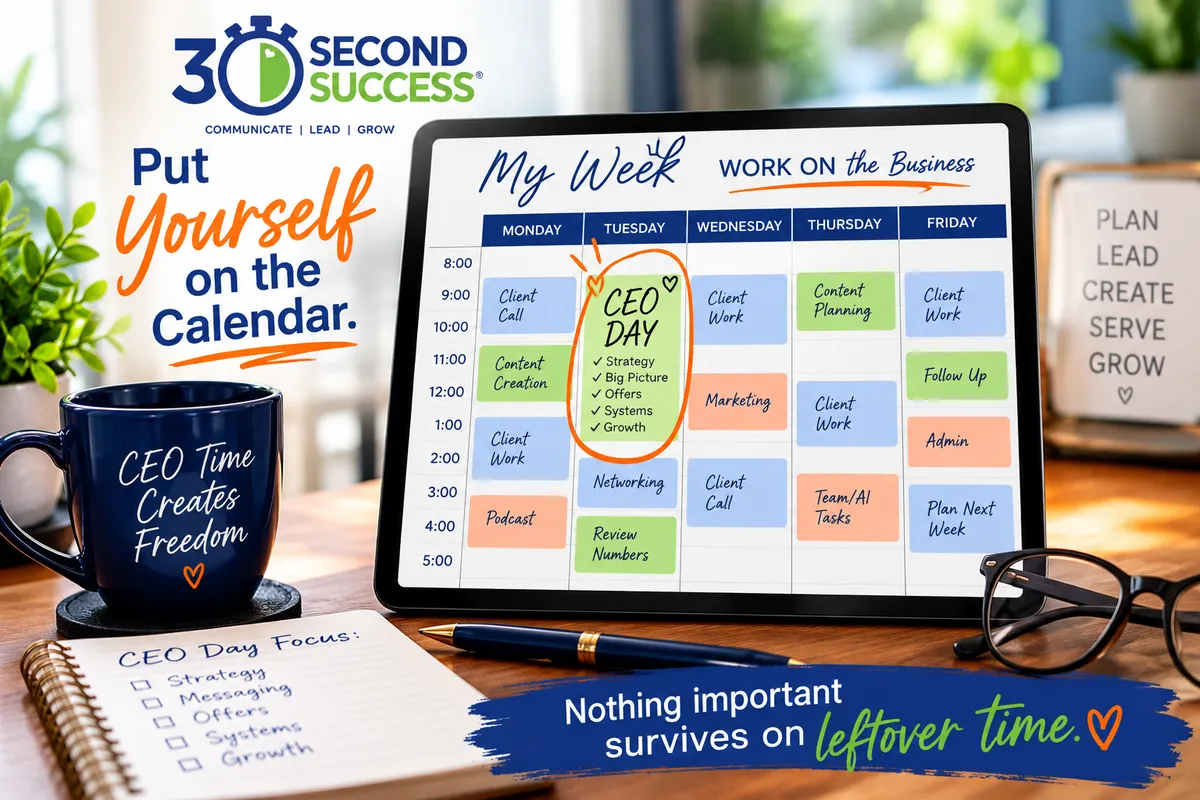
Working on Your Business: Why CEO Time Must Be a Priority
When Do You Fit Yourself Into Your Own Business?
We become exceptionally good at keeping promises to clients while quietly becoming the person we cancel on first.
There’s a question I’ve been asking myself lately:
Where do I fit into my own workday?
Not my clients.
Not the podcast.
Not the meetings, emails, networking conversations, content deadlines, collaborations, or the dozens of little things that somehow find their way onto my calendar.
Me.
More specifically, the work I need to do on my own business.
When does that happen?
If you're an entrepreneur, business owner, coach, or consultant who wears all the hats, you probably know exactly where this is going.
We are often incredibly disciplined about showing up for everyone else.
A client books an appointment? It goes on the calendar.
Someone invites us onto a podcast? Block the time.
A networking meeting? We're there.
A client needs something by Thursday? Thursday it is.
But when we decide that Tuesday morning from 9:00–11:00 is going to be dedicated to working on our own business?
Suddenly that time becomes remarkably negotiable.
Something comes up.
Someone needs us.
An email looks urgent.
A client asks if we're available.
And before we know it, the time we reserved for ourselves has disappeared.
Again.
We Keep Breaking Appointments With Ourselves
Here's what I've realized:
When we continually put ourselves last in our own businesses, we're not simply creating a scheduling problem. We're creating a trust problem.
We are teaching ourselves that everyone else's priorities matter more than our own.
Think about that for a minute.
If a client repeatedly scheduled meetings with you and then canceled them because something "more important" came up, how would you feel?
Eventually, you'd probably stop trusting that person to honor their commitments.
Yet we do exactly that to ourselves.
We block two hours to work on our strategy.
Cancel it.
We decide we're finally going to update our messaging.
Move it to next week.
We promise ourselves we'll develop that new offer.
After we finish everything else.
We say we're going to spend Friday afternoon reviewing our numbers and planning the next quarter.
And then Friday afternoon becomes the dumping ground for everything we didn't finish during the week.
Eventually, something deeper starts happening.
We stop believing ourselves.
The Emotional Cost of Always Putting Yourself Last
This isn't talked about nearly enough.
What happens internally when you continually postpone the things you know matter?
You become frustrated.
Then disappointed.
Then overwhelmed.
And sometimes resentful.
You look around and think:
Why isn't my business growing the way I want it to?
But underneath that question may be another one:
When was the last time I actually gave my business my undivided attention?
That's uncomfortable.
Because sometimes the problem isn't that we don't know what to do.
We simply haven't created the space to do it.
And every time we postpone ourselves, the things we haven't done remain quietly running in the background.
The website that needs updating.
The offer that needs refining.
The financial numbers we haven't reviewed.
The systems that need simplifying.
The follow-up process that needs fixing.
The content strategy we keep saying we'll develop.
The big idea God has placed on our heart that we keep promising we'll get to "when things slow down."
Those unfinished decisions consume mental energy.
Eventually, what started as a calendar problem begins affecting our confidence.
We start confusing lack of progress with lack of ability.
Those are two very different things.
You may be completely capable of building the next version of your business.
You simply haven't given yourself enough uninterrupted time to build it.
Your Business Needs More Than the Worker Version of You
Every business owner wears multiple hats.
Some days we're delivering the service.
Some days we're marketing.
Some days we're selling.
Some days we're answering email, solving problems, sending invoices, creating content, and wondering why there are seventeen browser tabs open.
But there are two roles we cannot afford to continually ignore:
Operations and CEO.
Operations asks:
How can this business run better?
CEO asks:
Where is this business going?
Those are very different questions from:
What needs to get done today?
And that's the trap.
Urgent work screams.
Important work whispers.
Your client deadline will demand your attention.
Your long-term strategy rarely does.
Your inbox will happily consume an hour.
Your business model will patiently wait six months for you to reconsider it.
Nobody is going to send you an email saying:
"Laura, you haven't spent enough time thinking about whether the business you're building actually supports the life you're trying to create."
That's CEO work.
And nobody can do it for you.
Put Yourself on the Calendar Before Everyone Else Takes It
Maybe we need to stop thinking about CEO time as something we'll squeeze into the week.
Because let's be clear:
Nothing important survives on leftover time.
Instead, what if we made appointments with our businesses?
Not vague promises.
Actual appointments.
CEO time.
Operations time.
Brand time.
Strategy time.
Whatever you want to call it, protect a recurring block of time when you are not serving today's business.
You are building tomorrow's.
Maybe that's two hours every Monday morning.
Maybe it's one afternoon each week.
Maybe it's thirty focused minutes every day.
The amount of time matters less than the commitment.
During that time, ask questions like:
What is working right now?
What is unnecessarily complicated?
What am I doing that someone else—or AI—could help me do?
Where is revenue actually coming from?
What am I spending time on that isn't producing meaningful results?
Is my message still aligned with the people I want to serve?
Are my offers supporting the business and life I actually want?
What needs my attention before it becomes a problem?
What opportunity have I been postponing because I've been "too busy"?
What is God asking me to steward differently in this season?
That last question matters to me.
Because stewardship isn't simply about managing money well.
It's also about managing our gifts, ideas, energy, opportunities, influence, relationships, and time.
If we've been entrusted with a business, continually putting its future at the bottom of our list probably isn't the best way to steward it.
Working In Your Business Feels Productive. Working On It Creates Progress.
There's another reason CEO work gets postponed.
It doesn't always give us the immediate dopamine hit of finishing something.
Answer an email: done.
Send an invoice: done.
Finish a client project: done.
Spend two hours reconsidering your positioning?
You may leave with three more questions than you started with.
But those two hours could change the direction of your next two years.
That's the difference between activity and advancement.
Both are necessary.
But they are not the same.
We can have incredibly busy weeks without moving our businesses meaningfully forward.
And that's one of the most dangerous kinds of busy because it feels responsible.
You Shouldn't Be the Person Your Business Gets After Everyone Else Is Finished With You
That may be the biggest realization of all.
Your business deserves more than your leftover energy.
And so do you.
If everyone else gets your best thinking, your highest energy, your creativity, your attention, and your follow-through, what's left for the dreams you're trying to build?
This isn't about becoming selfish.
It's about becoming intentional.
There will always be someone who wants a piece of your calendar.
There will always be another email.
Another invitation.
Another task.
Another opportunity.
Another person who would gladly take the two hours you had planned to give yourself.
The question is whether you will let them.
Because when you begin keeping your commitments to yourself, something changes.
You begin trusting yourself again.
You make decisions you've been postponing.
You finish things that have been hanging over your head.
Your confidence grows because you're finally seeing evidence of forward movement.
And perhaps most importantly, you stop feeling like you're chasing your business and start feeling like you're leading it.
A 30-Second Pause
Take a look at your calendar for next week.
Where are you?
Not your client work.
Not your appointments.
Not the obligations you've made to everyone else.
Where have you made room to lead the business God has entrusted to you?
If you can't find that time on your calendar, there's your answer.
Before you add one more thing to your week, block the time.
Protect it.
Keep the appointment.
Because you wouldn't continually cancel on your best client.
Maybe it's time to stop canceling on yourself.
#CompassionateLeadership


