Wishing for Simpler
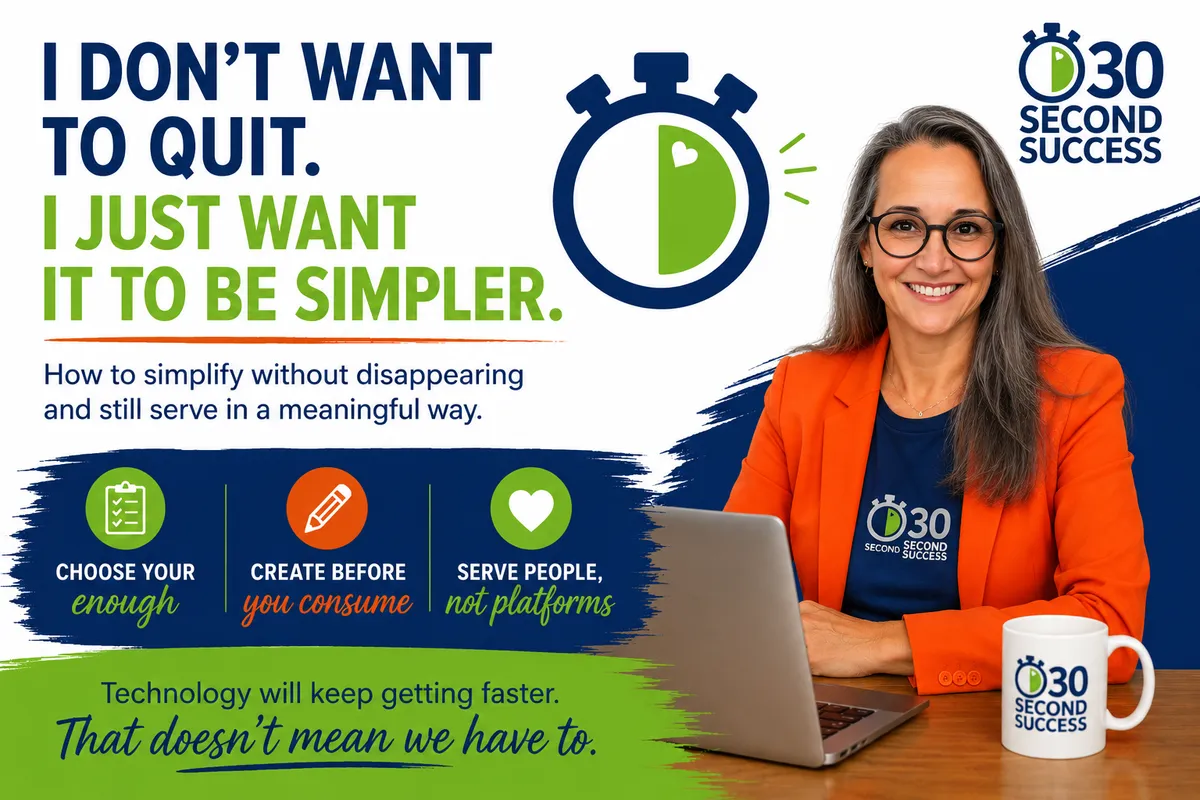
I Don't Want to Quit. I Just Want It to Be Simpler.
There are days when I find myself longing for simpler times.
Not necessarily the good old days. I remember enough about dial-up internet and fax machines to know we don't need to romanticize everything.
But I do miss the feeling that you could actually keep up.
You could learn how something worked, get reasonably good at it, and trust that the rules wouldn't completely change before you finished your morning coffee.
Today?
The goal posts keep moving.
Social media algorithms change. Platforms change. Marketing strategies change. Search changes. Technology changes. And now AI seems to be accelerating all of it.
Just when we think we've figured out what we're supposed to be doing, someone announces:
"That's not working anymore."
Wonderful.
So we learn another platform.
Try another strategy.
Download another app.
Subscribe to another newsletter.
Watch another video explaining the thing we apparently should have started doing six months ago.
And somewhere along the way, something that was supposed to make our lives easier starts making us feel incredibly tired.
I've found myself wondering:
How do we simplify without quitting altogether?
Because I don't want to quit.
I still want to serve.
I still want to create.
I still want to connect with people.
I still want to share ideas that might help someone think differently, communicate more clearly, lead more compassionately, or take the next brave step.
I just don't want to spend my life chasing a moving target.
And perhaps that's the distinction we need to make.
We Were Never Designed to Process This Much
Our exhaustion isn't entirely imaginary.
Researchers at the University of California, San Diego once estimated that the average American consumed roughly 34 gigabytes of information and about 100,000 words every day through television, radio, the internet, games, phones, newspapers, and other media.
And that study was based on 2008 consumption.
Before TikTok.
Before Threads.
Before today's endless short-form video feeds.
Before generative AI could produce articles, videos, images, emails, posts, podcasts, summaries, and ideas faster than any human being could possibly consume them.
Even then, researchers estimated Americans were consuming information for nearly 12 hours every day.
That doesn't mean we're consciously reading and processing every one of those words. Much of it is simply flowing past us.
But our brains are still being asked to constantly decide:
Do I pay attention to this?
Do I ignore it?
Do I respond?
Is this important?
Should I learn this?
Should I try this?
Am I falling behind?
And that last question might be the most exhausting one of all.
Information Overload Becomes Decision Overload
The problem isn't simply the amount of information.
It's the number of decisions the information creates.
Research into "choice overload" has found that when decisions become more complex, difficult, or uncertain, having more options can actually make choosing harder.
We hesitate.
We second-guess.
We defer decisions.
We wonder whether there is a better option we haven't discovered yet.
And eventually we become tired of deciding.
We've seen this phenomenon outside of business, too. An American Psychological Association survey during the pandemic found that nearly one-third of American adults said their stress sometimes became so great that they struggled to make even basic decisions.
That's worth paying attention to.
Because information doesn't simply occupy our screens.
It occupies our mental bandwidth.
And when our mental bandwidth is constantly being consumed by things that might matter, we have less capacity for the things that actually do.
Our families.
Our relationships.
Our creativity.
Our health.
Our faith.
Our ability to sit quietly long enough to hear ourselves think.
And, yes, our businesses.
Maybe our biggest challenge isn't learning how to consume more information.
Maybe it's learning how to protect our attention.
AI Isn't the Problem. Our Relationship With "More" Might Be.
You know I'm an advocate for AI.
I believe it can help us think, create, communicate, streamline, and reclaim enormous amounts of time.
But there's a strange irony happening.
We created tools capable of helping us do more.
So what did we do?
We decided we should do more.
We can create five social posts instead of one, so we create five.
We can publish on six platforms, so we publish on six.
We can generate another article, another video, another email sequence, another graphic, another lead magnet...
So we do.
Then we wonder why we're exhausted.
Maybe AI's greatest opportunity isn't helping us produce more.
Maybe it's helping us need to do less.
That requires a very different mindset.
Instead of asking:
"What else could I be doing?"
Perhaps the better question is:
"What is actually worth doing?"
That question changes everything.
Three Ways I'm Choosing to Simplify
I'm not interested in abandoning technology or disappearing from the internet.
I am interested in becoming much more intentional about where I spend my energy.
Here are three practices I'm leaning into.
1. Choose Your "Enough"
There will always be another platform.
Another strategy.
Another expert.
Another AI tool.
Another algorithm update.
You don't have to follow all of them.
Decide what enough looks like for you.
Maybe you don't need to be everywhere.
Maybe you need one place where you publish your deeper thinking and one or two places where you connect with people.
Maybe you don't need seven pieces of content this week.
Maybe one meaningful idea, thoughtfully shared and repurposed, can do more than seven rushed ones.
Define your minimum effective presence:
Where do my people actually need me to show up—and what can I release?
Everything doesn't deserve equal access to your time.
2. Create Before You Consume
This one may be the hardest.
Before checking feeds, newsletters, analytics, trending topics, or what everyone else is saying, spend some time with your own thoughts.
Write.
Pray.
Journal.
Walk.
Think.
Create something before allowing the world to tell you what you should be thinking about.
Because when we begin every day consuming other people's ideas, it's incredibly easy to lose connection with our own.
AI can help us expand an idea.
Social media can help us distribute it.
Google can help us research it.
But the starting point can still be you.
Your experiences.
Your observations.
Your convictions.
Your curiosity.
Your voice.
Technology should amplify your thinking, not replace it.
3. Stop Confusing Visibility With Service
This may be the biggest one.
More posts don't necessarily mean more impact.
More followers don't necessarily mean more connection.
More activity doesn't necessarily mean more service.
Sometimes serving well looks remarkably small.
One meaningful conversation.
One thoughtful email.
One useful article.
One introduction between two people who should know each other.
One person who reads something you wrote and thinks:
"I needed that today."
Algorithms measure reach.
They cannot fully measure impact.
And I think we've allowed ourselves to forget that.
Maybe the Goal Posts Don't Matter as Much as We Think
Algorithms will continue changing.
AI will continue evolving.
Platforms will rise and fall.
Someone will undoubtedly announce another "game-changing strategy" before I finish writing this sentence.
We can't control that.
But we can control whether every change receives our immediate attention.
We can decide what deserves our energy.
We can decide where we want to show up.
We can decide what meaningful service looks like.
And we can give ourselves permission to stop chasing every moving goal post.
Because perhaps simplifying doesn't mean walking away.
Perhaps simplifying means coming back.
Back to our purpose.
Back to our people.
Back to meaningful conversations.
Back to thoughtful work.
Back to the things we were called to do before an algorithm convinced us we weren't doing enough.
Technology will keep getting faster.
That doesn't mean we have to.🧡💚💙
A 30-Second Pause
Before you add one more platform, strategy, tool, or task to your life, ask yourself:
Is this helping me serve more meaningfully—or is it simply giving me one more thing to keep up with?
And then ask the harder question:
What would I stop doing if I truly believed I was already doing enough?
Maybe simplifying isn't quitting.
Maybe it's finally deciding what deserves to stay.


