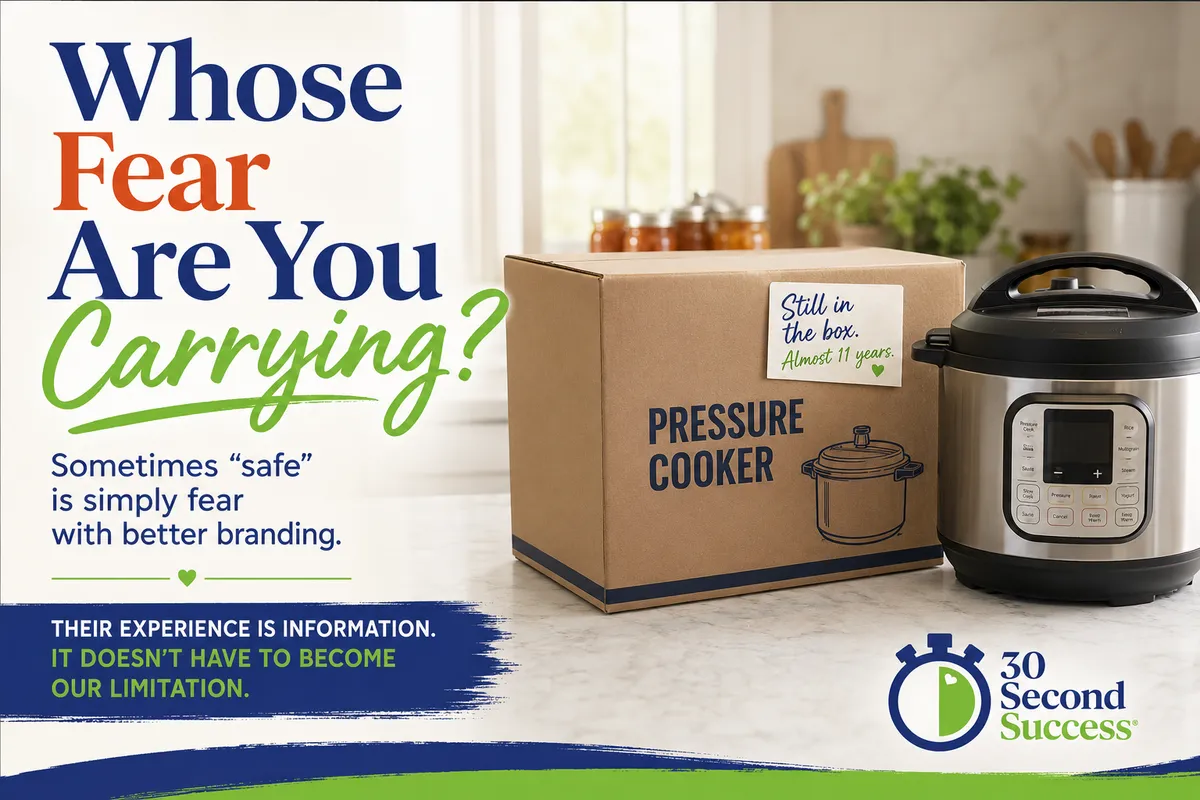
Whose Fear Are You Carrying?
Some of the fears keeping us small didn't start with us.
They were handed to us by people who loved us.
People who wanted to protect us.
People whose warnings were based on very real experiences that taught them what was dangerous, what could hurt, and what should be avoided.
And because we trusted them, we rarely stopped to ask whether what was dangerous for them, then was still dangerous for us, now.
We simply learned:
Don't do that.
Don't trust that.
Don't risk that.
Stay away from that.
Be careful.
Over time, their experience can quietly become our belief.
Their caution becomes our caution.
Their fear becomes our fear.
And eventually, we don't even remember where the fear came from.
We just know there's a pressure cooker sitting in the house that's been in the box for almost eleven years.
At least, there is in mine.
The Fear That Belonged to Nana
My Nana was terrified of pressure cookers.
Not mildly uncomfortable.
Terrified.
Growing up, I didn't completely understand why. I simply understood that pressure cookers were dangerous.
That was enough.
When someone you love and trust has a strong reaction to something, particularly when you're young, you don't necessarily investigate the evidence.
You absorb the lesson.
Eventually, I learned there was a reason behind Nana's fear.
Pressure cookers in the 1940s were very different from the ones we have today. Earlier models lacked many of today's built-in safety features, and accidents could be serious.
Somewhere along the way, Nana experienced one of those accidents.
It left her emotionally scarred for life.
So let's be clear:
Nana's fear wasn't irrational.
It was learned through pain.
Her brain had done exactly what our brains are designed to do after a frightening experience:
Remember this. Don't let it happen again.
The problem wasn't that Nana learned to fear pressure cookers.
The interesting part is that I did too.
Without the accident.
Without the emotional scars.
Without ever having used one.
Her experience had become my evidence.
We Inherit More Than Eye Color
I've been thinking about how often this happens.
Families pass down stories, traditions, recipes, sayings, values, beliefs, habits—and fears.
Sometimes those fears are communicated directly.
"People like us don't do that."
"Don't get your hopes up."
"You'd better have something to fall back on."
"Don't draw too much attention to yourself."
"Don't trust people too quickly."
"It's safer to stay where you are."
But sometimes nobody actually says anything.
We learn by watching.
We see how our parents respond to money.
Risk.
Failure.
Conflict.
Success.
Authority.
Relationships.
Change.
Visibility.
And we begin creating rules about how the world works.
Then those rules follow us into adulthood.
They follow us into our businesses.
They follow us into leadership.
They follow us into relationships.
They follow us into opportunities we say we want—and then somehow find reasons not to pursue.
That's where this gets uncomfortable.
Because eventually we have to ask:
How many decisions am I making based on something I've actually experienced—and how many am I making based on someone else's experience that I absorbed as my own?
I Bought the Pressure Cooker
Almost eleven years ago, my daughter was getting married.
On her bridal registry was—you guessed it—a pressure cooker.
My internal Nana alarm immediately went off.
A pressure cooker?
Nope.
Dangerous.
Exploding kitchen appliance.
Absolutely not.
But my daughter explained that pressure cookers had changed.
They were safer.
They had features that didn't exist when Nana had her experience.
Technology had evolved.
So I did something important.
I reconsidered what I believed.
I looked at new information instead of relying exclusively on an old story.
And I bought her a pressure cooker.
Then I did something even more surprising.
I bought one for myself.
Look at me breaking generational cycles!
Except...
Mine is still in the box.
Almost eleven years later.
And THAT may be the most important part of this story.
Changing Your Mind Isn't the Same as Changing Your Behavior
I intellectually challenged Nana's fear eleven years ago.
I gathered new information.
I understood that the circumstances had changed.
I recognized that today's pressure cooker wasn't Nana's pressure cooker.
I bought one.
But I never used it.
That's an important distinction.
Because sometimes we tell ourselves we've overcome something simply because we no longer consciously believe it.
But our behavior tells a different story.
We say we're comfortable being visible...
but don't post the video.
We say failure is part of growth...
but only pursue opportunities we're reasonably certain we'll get.
We say we don't care what people think...
and then spend three hours rewriting one LinkedIn post.
We say we're ready for something bigger...
but keep making decisions designed for the smaller version of our lives.
We changed our thinking.
But we never opened the box.
Fear Can Disguise Itself as Wisdom
This is where inherited fear gets tricky.
Because fear rarely walks into the room and introduces itself:
"Hello, I'm an irrational belief you've been carrying since childhood."
That would be convenient.
Instead, fear often sounds incredibly responsible.
"I'm just being realistic."
"Now isn't the right time."
"I should probably wait."
"I need to learn a little more first."
"What if something goes wrong?"
"Better safe than sorry."
Sometimes those statements are absolutely true.
But sometimes "safe" is simply fear with better branding.
And that's why we have to become curious about our own resistance.
Not reckless.
Curious.
There's a big difference.
Ask Better Questions of Your Fear
When something makes us hesitate, instead of immediately obeying the fear—or trying to bulldoze our way through it—we can examine it.
Ask:
Where did I learn this?
Can I remember an experience that created this belief, or did I inherit it from someone else?
What was true then?
Maybe the person who taught me this had very good reasons for believing it.
What's true now?
Have circumstances, technology, information, resources—or I—changed?
What is the actual risk?
Not the imagined catastrophe. The real, current risk.
What safeguards exist today that didn't exist then?
Knowledge? Experience? Technology? Boundaries? Support? Resources?
And finally:
Is this fear protecting me from genuine danger—or protecting me from discomfort?
Those are very different things.
Growth frequently involves discomfort.
It should not require recklessness.
Wisdom helps us know the difference.
We Don't Have to Reject the Person to Reject the Fear
This may be the most compassionate part of breaking inherited patterns.
We don't have to decide the person who taught us the fear was wrong.
Nana wasn't wrong.
She was hurt.
Her fear made sense based on what happened to her.
I can have compassion for her experience without making it the blueprint for mine.
That's an important lesson far beyond pressure cookers.
Our parents and grandparents made decisions based on the world they knew.
Our mentors give advice based on what they've experienced.
Our friends warn us based on what has happened to them.
Even people who deeply love us sometimes tell us not to take a risk because they are imagining themselves taking it.
They're measuring our opportunity against their tolerance for uncertainty.
And because we love and respect them, we can mistake their fear for wisdom.
Sometimes it is wisdom.
Sometimes it isn't.
Discernment means learning the difference.
Their experience is information. It doesn't have to become our limitation.
Honoring the Past Without Living In It
There's something else I've realized.
Moving beyond Nana's fear doesn't dishonor Nana.
Quite the opposite.
I can acknowledge what happened to her.
I can understand why it frightened her.
I can appreciate why she wanted the people she loved to stay far away from the thing that hurt her.
And I can still choose differently.
That's growth.
Maybe part of maturity is learning to hold two truths at once:
What happened to you was real.
And...
It doesn't have to happen to me.
We can honor the lessons of the people who came before us without recreating the boundaries their experiences created.
Eleven Years Later, I'm Opening the Box
Which brings me to this week.
My daughter and I are planning to do some canning.
And we're going to use both pressure cookers.
Hers.
And mine.
The one still sitting in the box.
After almost eleven years.
I suspect when I open it, part of Nana's story will be standing there with me.
And that's okay.
I'm not trying to erase her fear.
I'm simply refusing to let it make the decision.
I'll read the instructions.
I'll learn how to use it correctly.
I'll respect the pressure.
I'll follow the safety precautions.
And then I'll use the thing.
Because overcoming fear doesn't mean pretending there isn't risk.
It means gathering the information you have today, respecting what you've learned from yesterday, and deciding for yourself what you're willing to do next.
Maybe courage isn't always some giant leap into the unknown.
Sometimes courage is much quieter.
Sometimes it's recognizing that the voice telling you don't do that isn't actually yours.
Sometimes it's realizing the thing you've been avoiding isn't nearly as dangerous as it once was.
Sometimes it's discovering you've already changed your mind—you simply haven't changed your behavior.
And sometimes...
courage looks like opening a box that's been sitting in your house for eleven years.🧡💚💙
A 30 Second Pause
Think about something you've been avoiding.
A conversation.
An opportunity.
A change.
A new direction.
A bigger stage.
A different way of doing business.
A dream you've quietly decided is too risky.
Then ask yourself:
Whose fear am I carrying?
Where did I learn it?
What was true when that fear was formed?
What's true today?
Is it protecting me from genuine danger...
or simply keeping me comfortably small?
You don't have to throw caution to the wind.
You don't have to ignore the wisdom of the people who came before you.
You don't even have to stop hearing their voices.
But you do get to decide whether those voices make your decisions.
Their experience is information. It doesn't have to become your limitation.
As for me?
I've got a pressure cooker to unpack.


