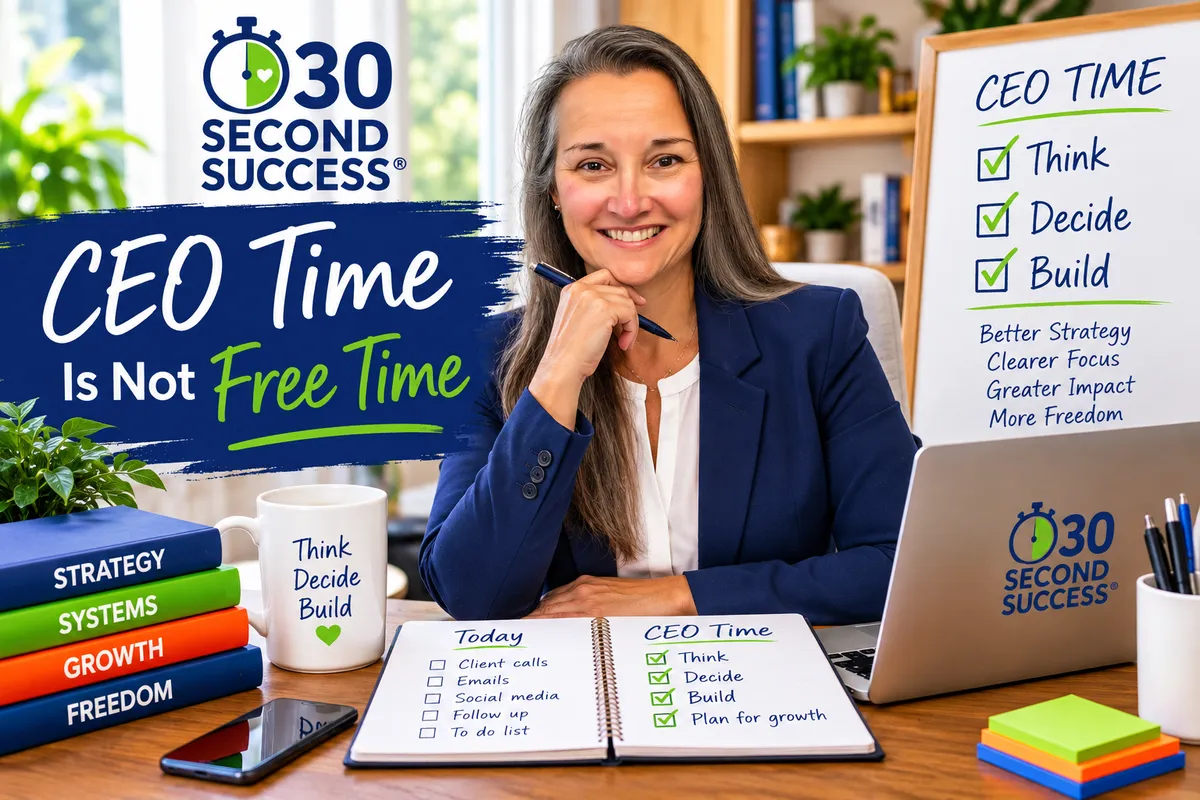
CEO Time for Entrepreneurs: Why It’s Not Free Time
CEO Time Is Not Free Time
Just because there isn't a client, meeting, or deadline attached to an hour on your calendar doesn't mean that hour is available.
In my previous article, When Do You Fit Yourself Into Your Own Business?, I challenged us to look at our calendars and ask a surprisingly uncomfortable question:
Where am I?
Where is the time dedicated to working on the business instead of simply working in it?
Because entrepreneurs can become exceptionally good at keeping promises to everyone else while quietly becoming the person we cancel on first.
But there's another side to that conversation.
Let's say you've done it.
You've blocked two hours on Tuesday morning and proudly labeled it:
CEO TIME.
Then Tuesday morning arrives.
You sit down.
Open your laptop.
And...
Now what?
Or worse, someone asks whether you're available Tuesday morning.
You look at the calendar.
Technically, there's no meeting there.
No client.
No appointment.
Nothing with another person's name attached to it.
So you think:
Well, I guess I'm free.
No.
You're not free.
You have a meeting with the CEO.
And if you're running your own business, that CEO happens to be you.
We've Confused Unscheduled With Available
This is something entrepreneurs have to learn.
White space on your calendar isn't necessarily free time.
Thinking time isn't free time.
Planning time isn't free time.
Reviewing your business isn't free time.
Working on your brand isn't free time.
Sitting quietly with a difficult decision isn't free time.
These things may not look like "work" in the traditional sense.
But they are work.
In fact, they may be some of the most important work you do.
The problem is that we've been trained to measure productivity by what we can see.
Emails sent.
Calls completed.
Projects delivered.
Invoices issued.
Posts published.
Boxes checked.
There's satisfaction in finishing something.
But leadership doesn't always produce an immediate deliverable.
Sometimes leadership produces a decision.
Sometimes it produces a question.
Sometimes it produces clarity.
Sometimes the result of two hours of thinking is:
We're not doing that anymore.
And that decision might save you hundreds of hours over the next year.
That's productive.
CEO Work Looks Different From Worker Work
When you're doing the work of your business, the next step is usually obvious.
There's something to complete.
A client needs a deliverable.
An email needs a response.
A podcast needs recording.
A proposal needs writing.
CEO work is different.
CEO work asks you to lift your head above today's to-do list and look farther down the road.
Where are we going?
Why are we going there?
Is this still the right direction?
What's working?
What's costing us time without producing results?
What are we doing simply because we've always done it?
What opportunity are we overlooking?
What needs to change?
What needs to stop?
That's not idle time.
That's leadership.
Your CEO Time Needs Three Things
I've been thinking about CEO time in three simple categories:
Think. Decide. Build.
Not every CEO session needs all three.
But understanding the difference can keep CEO time from turning into two hours of staring at your laptop wondering what you're supposed to be doing.
1. THINK
Thinking time gives you permission to step away from production.
Review what's happening.
Look at your numbers.
Read client feedback.
Examine your calendar.
Look at what's generating revenue.
Notice what drains your energy.
Think about the conversations you're having with clients.
Pay attention to the questions people keep asking.
Ask yourself:
What am I noticing that I haven't stopped long enough to think about?
This is where patterns emerge.
And patterns are valuable.
Your next offer may already be hiding inside the questions your clients keep asking.
Your next marketing message may be hiding inside a conversation you had last week.
Your biggest time-saving opportunity may be hiding inside a task you've repeated manually fifty times.
But you won't necessarily notice those things while you're racing through your day.
You need enough space to see them.
2. DECIDE
Thinking without deciding can become its own form of procrastination.
Eventually, leadership requires a decision.
What are we going to pursue?
What are we going to stop?
What gets our attention this quarter?
What doesn't?
Which offer are we going to market?
Who are we really trying to serve?
Where should we be showing up?
What needs to be simplified?
What needs to be delegated?
What can AI help us do more efficiently?
What sounded like a great idea three months ago but doesn't make sense anymore?
Sometimes CEO time should end with one sentence:
I've decided ____________.
That decision gives direction to everything that comes next.
3. BUILD
Then there's the work that turns the decision into reality.
This is where strategy becomes action.
Maybe you're refining an offer.
Updating your brand message.
Creating a new system.
Mapping out a campaign.
Developing intellectual property.
Documenting a process.
Building an asset that can continue creating value without requiring your constant involvement.
That's different from routine production.
You're not simply completing today's work.
You're creating something that changes how tomorrow's work gets done.
That's CEO work.
Thinking Is Not Wasting Time
This may be the hardest part for entrepreneurs who have spent years being doers.
Sitting in a chair thinking can feel ridiculously unproductive.
There isn't anything to show for it.
Nobody applauds.
Nothing gets posted.
No client says thank you.
There's no satisfying ding from checking something off the list.
And yet, sometimes you need to sit there.
Think.
Pray.
Write.
Question.
Notice.
Imagine.
There are moments when the most responsible thing you can do for your business is close the inbox and give yourself enough quiet to hear yourself think.
And for me, there's another piece.
I need enough quiet to listen for God's direction too.
It's difficult to discern direction when everything around us is constantly demanding a response.
Sometimes we're asking God for clarity while filling every available moment with noise.
Maybe the answer isn't another task.
Maybe it's space.
CEO Time Also Means Looking at What You're Building
Here's a question I think we need to ask more often:
Is the business I'm building creating the life I actually want?
That's a CEO question.
Because growth for the sake of growth isn't necessarily success.
More clients aren't automatically success.
More revenue isn't automatically success.
More followers aren't automatically success.
More offers aren't automatically success.
If "more" requires you to build a business you don't actually want to run, that's worth noticing.
Maybe your next level doesn't require adding.
Maybe it requires simplifying.
Maybe it requires turning what you know into intellectual property.
Maybe it requires creating assets instead of adding services.
Maybe it requires fewer offers with clearer positioning.
Maybe it requires systems that allow you to step away without everything stopping.
Those decisions rarely happen while answering email.
They happen when you deliberately create room to think about the business you're building.
Protect the Appointment
This brings us right back to the calendar.
If you've blocked CEO time, stop treating it as available time.
When someone asks:
"Are you free Tuesday morning?"
You don't have to say:
"Well, technically I'm just meeting with myself..."
You're booked.
That's enough.
Protecting CEO time doesn't mean becoming inflexible or refusing to help people.
Emergencies happen.
Life happens.
Priorities shift.
But there should be a difference between intentionally changing your schedule and habitually sacrificing your priorities.
One is leadership.
The other becomes a pattern.
Try This at Your Next CEO Meeting
Before you open your inbox, ask yourself three questions:
THINK: What am I noticing in my business right now?
DECIDE: What decision have I been postponing?
BUILD: What can I create, change, simplify, document, or systematize that will make the business stronger tomorrow?
Then choose one.
You don't have to redesign your entire business before lunch.
You simply need to use the time intentionally.
Because CEO time isn't the absence of work.
CEO time is the work that determines which work deserves to happen next.
And that makes it some of the most valuable time on your calendar.
#CompassionateLeadership


