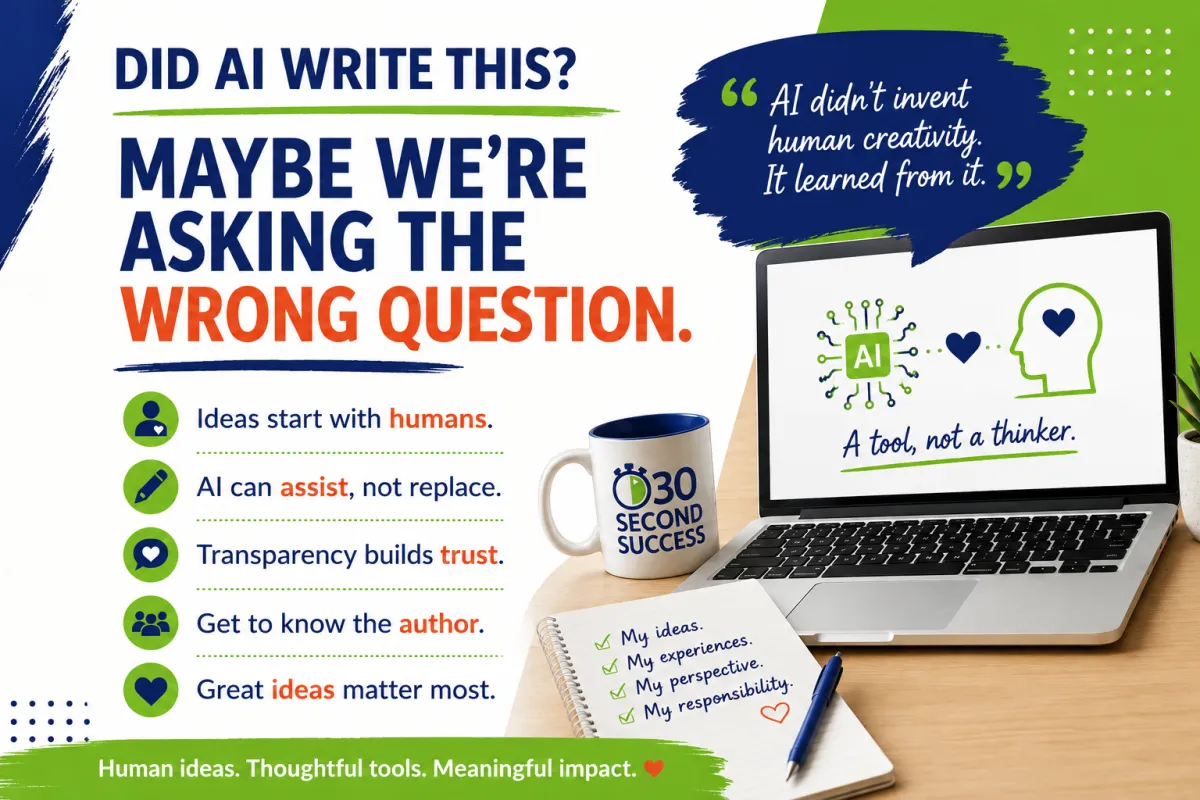
Did AI Write This? AI Transparency, Authenticity & the Future of Writing
Maybe We’re Asking the Wrong Question
Apparently, good grammar is suspicious now.
If you use complete sentences, understand punctuation, avoid unnecessary repetition, and know the difference between their, there, and they’re, congratulations:
You may be accused of being AI.
Welcome, fellow English-class nerds. What a time to be alive.
There’s something both amusing and deeply frustrating happening in the writing world right now. As AI tools have become more accessible, readers, publishers, educators, platforms, and writers themselves are trying to figure out what constitutes “authentic” writing.
And somewhere along the way, AI detection software entered the conversation.
Software that uses artificial intelligence to determine whether we used artificial intelligence.
Oh, the irony.
But underneath the humor is a legitimate concern.
People want to know whether the person whose name appears on an article actually had something to do with creating it.
I think that’s fair.
What I’m not convinced of is that asking, “Did you use AI?” tells us what we really want to know.
Perhaps the better questions are:
Whose ideas are these?
Does this represent what the author actually believes?
Can the author stand behind what was written?
And is the content worth our time?
Those questions get us much closer to the heart of authorship.
Writers Are Feeling This From Both Sides
There is a very real emotional frustration happening among writers right now.
Some writers have spent decades learning their craft. They studied grammar. They learned sentence structure. They understand transitions, rhythm, word choice, storytelling, and how to organize an argument.
They love language.
Then they run something they wrote entirely themselves through an AI detector and discover that a machine has decided a machine probably wrote it.
That doesn’t simply feel inaccurate.
It can feel insulting.
Particularly when you realize that large language models learned patterns of human language from enormous collections of existing text.
In other words, AI learned to write by studying human writing.
So when an experienced writer is told, “This sounds like AI,” there’s an uncomfortable irony hiding underneath that accusation.
Maybe AI sounds like us.
Writers developed the patterns first.
Clear structure. Strong transitions. Proper grammar. Organized thinking. Intentional word choice.
Those aren't AI inventions.
They're writing skills.
And yet the frustration on the other side is legitimate, too.
Readers are encountering content that feels generic, repetitive, impersonal, and disconnected from any real human experience.
We’ve all seen it.
Content that contains plenty of words and very little thought.
That isn’t necessarily an AI problem.
It’s an authorship problem.
AI Shouldn't Be the Starting Point
This is where I believe we need to make an important distinction.
There is a significant difference between asking AI:
"Write me an article about leadership."
and saying:
"Here’s something that happened to me yesterday. Here’s what it made me realize about leadership. Here’s what I believe. Help me explore this idea, challenge my thinking, organize it, and turn it into something useful for the people I serve."
Those aren't the same creative process.
For me, the human idea should come first.
Your experience.
Your observation.
Your frustration.
Your curiosity.
Your expertise.
Your story.
Your faith.
Your perspective.
Your weird little thought that popped into your head while standing in the grocery store, walking the dog, talking to a client, driving home, or drinking your second cup of coffee.
That's the intellectual starting point.
AI can help you develop it.
It can ask questions.
It can help you research.
It can identify gaps in your reasoning.
It can help organize scattered thoughts.
It can challenge an assumption.
It can suggest another angle.
It can clean up grammar or tighten a sentence.
It can help you turn one idea into several formats.
But there should still be a you underneath all of it.
Otherwise, what exactly are we building a personal brand around?
Transparency Matters—But So Does Context
I believe creators should be transparent about meaningful AI use.
Not because AI is something shameful that needs to be confessed.
Because trust matters.
If AI played a role in helping you research, brainstorm, organize, edit, or develop something, there is nothing wrong with saying so.
In fact, I think transparency may become an increasingly important part of personal branding.
But disclosure also needs some nuance.
If someone uses spellcheck, Grammarly, transcription software, an editor, a researcher, Google, a thesaurus, or a colleague who says, “That paragraph doesn't make sense,” we don't typically question whether that person is still the author.
So the mere presence of assistance cannot be the only standard.
The question is how much intellectual ownership remains with the person whose name is on the work.
That's the line I care about.
AI can assist my thinking. It shouldn't replace my thinking.
How Do We Stay Human in an AI-Assisted World?
For writers who want to use AI while keeping their work unmistakably their own, I think there are a few practices worth protecting.
Start with your own idea before opening the AI tool. Jot down the story, argument, question, lesson, opinion, or experience first. Give AI something you created to work with instead of asking it to manufacture your perspective.
Keep your natural language. If you always say “Here's the thing,” don't let AI turn you into someone who suddenly says, “It is imperative to recognize the multifaceted nature of...” Nobody talks like that over coffee.
Include details AI couldn't invent without you. The conversation you remember. The mistake you made. The thing your grandfather used to say. The moment you changed your mind. The client question that stopped you in your tracks. Those details aren't imperfections in your content.
They're fingerprints.
Read your work aloud. If you wouldn't say it, ask yourself why you're publishing it.
Challenge AI instead of simply accepting its suggestions. Tell it, “That's not what I mean.” Push back. Rewrite. Add context. Disagree.
That's collaboration.
And perhaps most importantly, be willing to disclose your process.
Something as simple as this can go a long way:
I use AI as a collaborative tool to help me explore, organize, research, and refine my original ideas. The experiences, perspectives, opinions, and final editorial decisions are my own.
No apology.
No defensiveness.
Just clarity.
And Let's Respect the Writers Who Don't Use It
This part matters just as much.
Using AI is a choice.
Not using AI is also a choice.
Both deserve respect.
Some writers don't want AI involved in their creative process. They love sitting with a blank page. They enjoy wrestling with sentences. The struggle itself is part of how they discover what they think.
Wonderful.
Protect that.
Other writers may have extraordinary ideas but struggle to organize them, type them, articulate them, edit them, or find the time to turn them into something other people can experience.
AI may finally give those people a bridge between the ideas inside their heads and the people who need to hear them.
That matters, too.
We don't need to turn this into another us versus them conversation.
Human creativity isn't a competition between people who use AI and people who don't.
What If AI Is the Reason We Got to Hear the Idea?
This is the question I keep coming back to.
Imagine someone has an extraordinary idea.
Something shaped by decades of experience.
Something that could encourage another person, solve a problem, change a business, strengthen a relationship, deepen someone's faith, or simply help another human being feel understood.
But that person isn't a writer.
Maybe writing takes them ten times longer than it takes someone else.
Maybe grammar intimidates them.
Maybe they have ideas pouring out of their head faster than they can organize them.
Maybe they never considered themselves articulate enough to publish anything.
So the idea stays inside them.
Never written.
Never published.
Never shared.
Never discovered by the person who needed it.
Now imagine AI helps them get it out.
Would we really prefer silence?
That's worth thinking about.
Because perhaps the goal shouldn't be protecting some romantic notion that every meaningful piece of writing must emerge from one human sitting alone with a blinking cursor.
Perhaps the goal is preserving human thought, human experience, human responsibility, and human connection—regardless of the tools that helped bring those things into the world.
Maybe Trust the Author Before You Trust the Detector
This may be where the conversation ultimately needs to go.
Get to know the people you read.
Pay attention to what they consistently say.
Watch how they show up.
Listen to them speak.
Read what they've written over time.
Understand what they believe.
Look for consistency between their words and their actions.
Then ask yourself:
Does this content sound like them?
Is it consistent with what they stand for?
Are they willing to defend, explain, and expand upon these ideas?
Did this make me think, learn, question, act, or see something differently?
If you trust the author, the ideas are genuinely theirs, the content aligns with who they are, and the work makes a meaningful difference...
Maybe the fact that AI helped them organize a paragraph isn't the most interesting thing about it.
Maybe we've been asking the wrong question.
Instead of:
“Did AI write this?”
Perhaps we should be asking:
“Is there still a human being worth listening to behind it?”
Because tools will continue to change.
The responsibility of authorship won't.
And neither will the importance of having something worth saying.


